Background
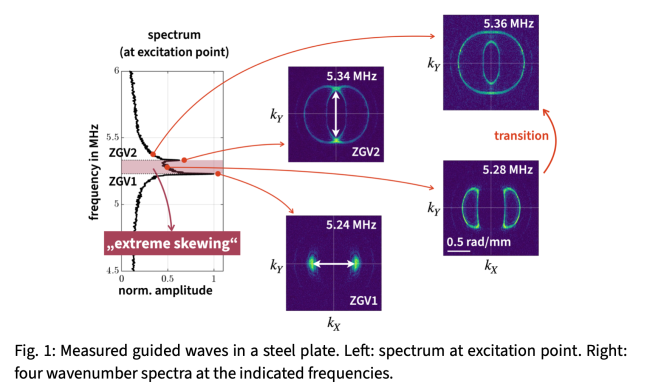
Due to their polycrystalline nature, industrial materials exhibit complex and diverse mechanical behavior. Determining their macroscopic stiffness tensor is not only important for design engineers, but also reveals information about the underlying microstructure. Guided elastic waves in plates are excellent candidates for high-sensitivity and high-accuracy stiffness characterization thanks to their strong dispersion. This is visualized in Fig. 1. Two resonances can be seen in the spectrum. The kx-ky-wavenumber spectra associated to four different frequencies are also depicted. The abrupt change of the wavenumber spectra is due to anisotropy.
Objective
Speed up the inverse characterization of anisotropic stiffness by exploiting automatic differentiation. This requires extending (GEWtool) appropriately, our guided wave analysis software based on MATLAB. Different cost functions will be compared in convenience and robustness within the new inversion framework. The cost function assesses how well the theoretical model matches the measurements. The sensitivity of the cost function towards changes in the stiffness parameters will be analyzed. A laser-ultrasonic measurement system is available to acquire wave fields if needed, but some data are already available. Samples of interest include nano-porous silicon, steel and chromium coated zirconium alloy.
Literature
- Kiefer, Mezil, and Prada, Phys. Rev. Res., 7(1), 2025, doi : 10.1103/PhysRevResearch.7.L012043
- Diboune et al., J. Acoust. Soc. Am., 159(1), 2026, doi : 10.1121/10.0042186.
Required qualifications
fundamental knowledge in wave propagation and continuum mechanics, fundamental programming skills, interest in doing measurements is advantageous.
Details and application
- Document :
- Location : Institut Langevin (1, rue Jussieu, 75005 Paris) – ESPCI, CNRS, Université PSL
- Application : contact Daniel Kiefer at
 with a CV and explaining your motivation in one or two paragraphs in your email. Languages : french, english, german, spanish.