

PhD Position — Deep Learning for Non-Invasive Imaging Through Strongly Scattering Media
PR[AI]RIE-PSAI 2026 — Funded PhD thesis (2026—2029)
Supervisors
– Sébastien Popoff (CNRS, Institut Langevin)
– Alexandre Aubry (CNRS, Institut Langevin)
In collaboration with
Arthur Goetschy and Baptiste Hériard-Dubreuil (ESPCI, Institut Langevin).
Location
Institut Langevin, ESPCI Paris — PSL, 1 rue Jussieu, 75005 Paris, France.
Context
Light passing through a strongly scattering medium, such as a thick biological tissue, undergoes multiple scattering events that tend to randomize its propagation. However, the response of such a system is not stochastic as long as the medium remains static : it is fully deterministic and can, in principle, be learned.
In more realistic approaches, one only has access to one side of the medium. We can define and measure a reflection matrix that links the wavefronts arriving on and reflected off the medium. While this object does not give direct access to the transmission properties of a random medium, it holds information both about the propagation medium and the hidden object to image. In the past 10 years, we developed approaches to separate these contributions and perform reconstruction of images deeper than using standard imaging approaches, both in ultrasound and optical imaging.
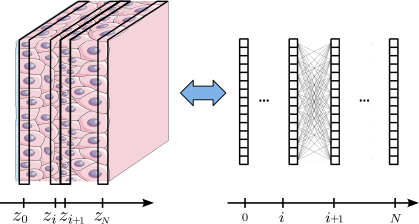
However, when the light is randomized by too many scattering events in an inhomogeneous medium, these contributions become difficult to discriminate. To tackle these issues, we recently started using differentiable models akin to deep learning frameworks to model the propagation medium, with each trainable parameter representing spatial physical properties of the medium we want to study.
Objectives
The goal of the project is to develop physics-informed networks using regularization based on experimental measurements to recover images deep inside scattering optical media akin to biological tissues.
The idea is, instead of trying to simultaneously optimize all the parameters of the full model, to use physical measurements for regularization and gradually train the model, starting from parameters closer to the surface before going deeper and deeper.
Work programme
– Year 1 — Validation of the approach through a simple phase-plate model. Using a succession of small-angle thin diffusers with an object to image behind it, we will measure the reflection matrix and train a forward-scattering model to learn the parameters representing the object.
– Year 2 — Imaging through thick scattering media via the transfer matrix approach. We will move to strongly scattering samples where backward scattering can no longer be neglected, using transfer matrices and extending the physical regularization strategy developed in Year 1.
– Year 3 — Deep tissue imaging. The object to image is the scattering medium itself (e.g. organs such as the liver or breast), using the Dyson series approach where the perturbation of the dielectric constant is also the physical quantity to recover.
How to apply
Applications should be sent by email to the supervisors :
– 
Required documents
– CV of the candidate.
– Motivation letter (one page) describing your ambitions for this research topic and the relevance of your profile with respect to the subject.
– Copies of recent diplomas (Master’s degree or equivalent).
Deadline
May 15, 2026.
Results will be communicated in two phases between May 30 and mid-June 2026.
Selection criteria
Selection follows an open, transparent and merit-based (OTM) recruitment process. Criteria include :
– Academic excellence,
– Proficiency in English is required,
– Good programming skills are expected, preferably in Python,
– Experience or coursework in one or more of the following areas is appreciated : light propagation in complex media, deep learning, statistical physics, signal processing.
Non-discrimination, openness and transparency
All partners of PR[AI]RIE-PSAI are committed to supporting and promoting equality, diversity and inclusion within their communities. We encourage applications from diverse backgrounds and ensure selection through an open and transparent recruitment process.