


Scientific context and motivation
The retina is the only part of the central nervous system that can be directly observed in a living human using light. This unique accessibility offers a remarkable opportunity to study neurovascular coupling and its alteration in neurodegenerative diseases such as Alzheimer’s disease.
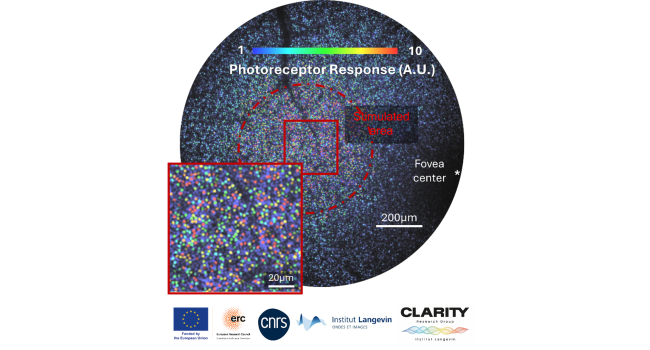
In our lab, we have recently developed advanced optical imaging methods that make it possible to observe nanometric structural changes occurring when retinal neurons respond to light stimulation. These developments open exciting perspectives for studying neuronal function and neurovascular interactions directly in the living human retina.
This PhD project is part of the European project MIRACLE-AD and aims to develop experimental and computational approaches to measure neuronal activity in the living human retina and investigate neurovascular coupling at cellular resolution.
PhD research project
The project relies on our Full-Field OCT retinal imaging system capable of recording high-speed 3D images of the living retina. These datasets contain subtle signals related to the activity of retinal neurons, but extracting these signals requires the development of advanced computational methods.
The PhD will focus on extracting functional signals from large volumetric datasets at the interface of optical instrumentation and computational imaging. More specifically, the project will involve :
- Operation and optimization of the retinal imaging platform
- Development of algorithms for volumetric image stabilization
- Extraction of functional signals from retinal neurons
- Quantitative analysis of neuronal dynamics
Research Environment
The PhD project will be carried out at Institut Langevin (CNRS – ESPCI Paris – PSL University) in Paris, an internationally recognized research laboratory in wave physics and optical imaging, with strong expertise in biomedical imaging technologies. The student will join the CLARITY research group, which develops advanced optical imaging systems for cellular-resolution imaging of the living human retina. The project will also benefit from a strong interdisciplinary environment through collaborations with clinicians and researchers at the Quinze-Vingts National Eye Hospital.
Candidate profile
We are looking for a highly motivated candidate with a background in physics, optics, biomedical engineering, or a closely related field.
- Strong background in physics, optics, or biomedical engineering
- Programming experience (Python, Matlab or similar)
- Interest in image processing or signal analysis
- Motivation for experimental and computational research
The candidate should be comfortable working with experimental systems and large imaging datasets. Curiosity for interdisciplinary research combining physics, biomedical imaging, and neuroscience will be highly appreciated.