

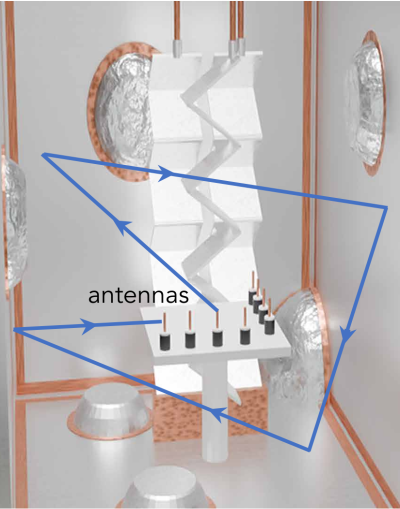
How efficiently can energy be directed through a complex, reverberant environment when only limited control is available? Consider a simple but practically relevant scenario: in a reverberant room equipped with eight antennas (see figure), suppose one can control the amplitudes and phases of signals injected through only four of them. How much energy can be delivered to two selected antennas elsewhere in the room? And how would this efficiency change if four antennas were targeted instead? Questions of this kind naturally arise in wireless communications, sensing, and energy delivery, yet answering them typically requires detailed, system-specific modeling.
In a recent Science Advances publication, a collaboration led by researchers from the Langevin Institute and Wesleyan University addresses this challenge by developing a general statistical framework for targeted mode transport (TMT) in wave-chaotic systems. Rather than attempting to suppress complex wave interference, their approach embraces it, revealing universal constraints on how efficiently energy can be routed between chosen sets of input and output channels.
Using tools from random matrix theory and diagrammatic methods, the authors derive analytical predictions for the full statistics of TMT efficiency, including strict bounds on the maximum achievable transmission. These bounds explicitly account for realistic effects such as absorption, imperfect coupling of the antennas, and incomplete channel control. A key outcome is the prediction that near-optimal, and sometimes nearly reflectionless, transport states occur with high probability, even in strongly chaotic environments with incomplete control. In contrast to disordered media, these predictions are independent of the mean free path, dimensionality, and system size.
The theory is validated experimentally across three complementary platforms: microwave networks, two-dimensional chaotic cavities, and three-dimensional reverberation chambers. The close agreement between theory, numerical simulations, and experiments highlights the robustness and generality of the results. Together, these findings provide practical guidance for designing wave-based technologies, from programmable wireless systems to targeted energy delivery.
Reference:
C.-Z. Wang, J. Guillamon, U. Kuhl, M. Davy, M. Reisner, A. Goetschy, T. Kottos,
Guiding waves through chaos: Universal bounds for targeted mode transport
Science Advances 12, eaeb1158 (2026)
Contact:
| Arthur GOETSCHY Tel.: +33 (0)1 80 96 39 46  |